



Kucuksu Rasathane
Uskudar Istanbul Turkey

Mon–Fri 09:00–18:00 (GMT+3)
Weekend: Closed

Euroclass B2ca • Indoor/Outdoor • LSZH
B2ca Fiber Optic Cable
B2ca Fiber Optic Cable is engineered for permanent building installations where reaction-to-fire performance, low smoke behaviour and dependable optical transmission all matter. The U-D(ZN)BH construction combines a dry loose tube design, non-metallic strength members and an LSZH outer sheath for indoor/outdoor routes, telecom backbones, campus links, FTTB distribution and protected FTTH building entries.
Available in 4, 6, 8, 12 and 24 fibers, this fully dielectric cable supports singlemode and multimode network designs while keeping installation practical in ducts, conduits and mixed-route building environments. Where the route is exposed to higher mechanical stress, the final installation method should be matched to the required protection level.
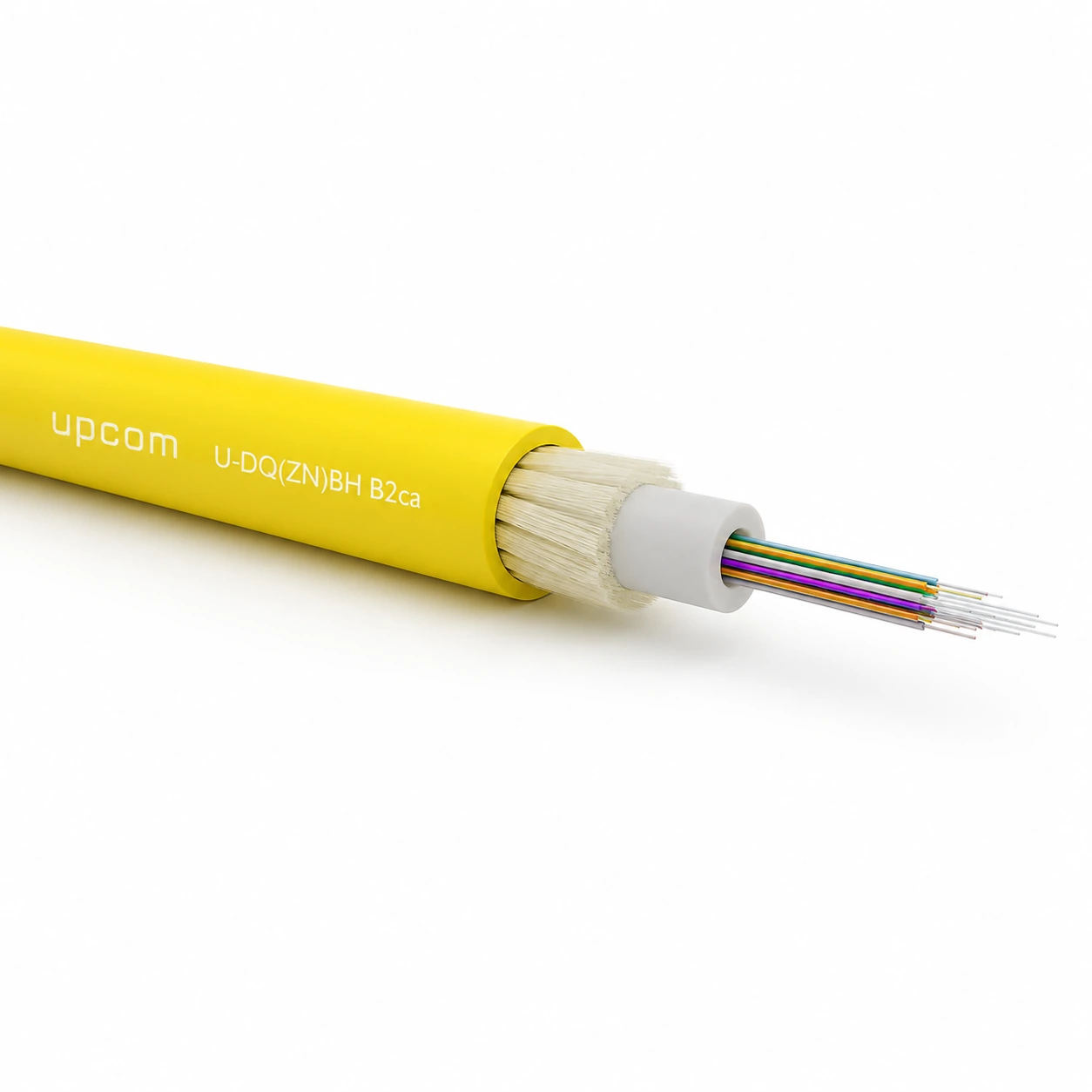
B2ca Fiber Optic Cable Overview
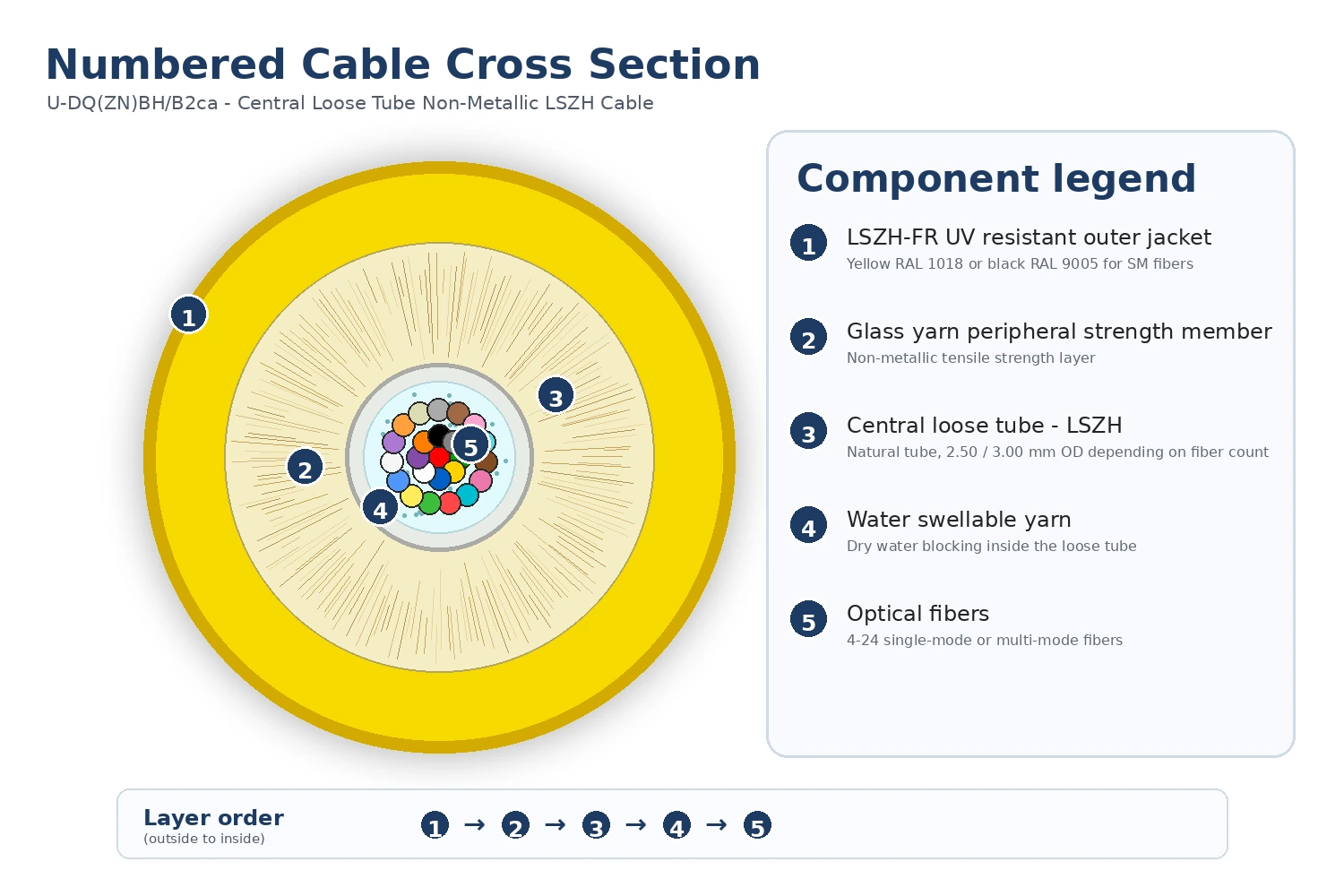
This B2ca fiber optic cable combines stronger reaction-to-fire performance with a compact, installation-friendly construction. Its dry tube and dry core design supports clean preparation, while glass yarn reinforcement and a UV-stabilized LSZH-FR outer sheath suit protected indoor/outdoor building routes.
Singlemode and multimode B2ca options
Suitable for singlemode G.652.D / G.657.A2 and multimode OM2 / OM3 / OM4 configurations, depending on the project architecture and transmission requirement.
Compact B2ca cable construction
Typical cable diameter is 6.1 mm for 4–12 fiber builds and 6.5 mm for 24 fiber builds, helping route planning in space-limited ducts, risers and access pathways.
Built for permanent building installations
A practical fit for telecom trunks, building backbones, campus links and distribution routes where CPR-related fire performance is part of the specification.
For a broader view of related constructions, visit our Fiber Optic and Data LAN Cables category page.
Key Benefits for Building Installations
Euroclass B2ca fire performance
Designed for projects where B2ca classification is specified for permanent building installations and stricter fire-performance expectations apply.
LSZH fiber cable safety profile
The LSZH-FR outer sheath supports low-smoke, halogen-free cable behaviour in occupied spaces, risers, technical rooms and enclosed pathways.
Fully dielectric cable design
Non-metallic strength elements help avoid electrical conductivity issues and support stable performance in telecom and data network environments.
Dry loose tube handling
Dry tube construction with water-swellable elements supports clean handling, simpler preparation and practical installation in protected route designs.
Indoor/outdoor routing flexibility
UV-stabilized sheath and compact construction make the cable suitable for mixed routes when the installation path is properly selected and protected.
Compact low-core B2ca format
A strong option when the project needs 4–24 fibers with a fire-rated construction, without moving to a bulkier cable family than necessary.
B2ca Fiber Optic Cable Technical Highlights
Available 4–24 fiber configurations include 4F, 6F, 8F, 12F and 24F variants with G.652.D or G.657.A2 singlemode fiber and OM2, OM3 or OM4 multimode fiber. Select the final ordering code by fiber type, fiber count and sheath colour after confirming the route and termination plan.
| CPR classification | B2ca-s1a,d0,a1 |
|---|---|
| Fiber counts | 4, 6, 8, 12, 24 fibers |
| Fiber options | Singlemode G.652.D / G.657.A2 and multimode OM2 / OM3 / OM4 |
| Construction | Dry loose tube, water-swellable yarn, glass yarn peripheral strength members, fully dielectric build |
| Outer sheath | UV-stabilized LSZH-FR compound |
| Cable diameter | 6.1 mm ± 0.2 for 4–12F; 6.5 mm ± 0.2 for 24F |
| Cable weight | 45 ± 10% kg/km for 4–12F; 50 ± 10% kg/km for 24F |
| Tensile force | 1000 N |
| Crush resistance | Max. 200 N/cm |
| Temperature range | Operation: -20 to +60 °C • Storage: -40 to +70 °C • Installation: 0 to +50 °C |
| Standard delivery length | 4000 m ± 5% |
Standard sheath colours are yellow or black for singlemode, orange for OM2 and turquoise for OM3 / OM4. Alternative tube, fiber, sheath colour, marking and drum-length options are available on request.
Applications and Typical Use Cases
Typical B2ca cable applications
- LAN and WAN backbone links inside buildings and campus environments
- FTTB distribution and protected FTTH building-entry routes
- Telecommunication connection lines and customer-side distribution frames
- Indoor/outdoor transitions in ducts, conduits and protected pathways
- Primary and secondary distribution in access network layouts
- Projects that require LSZH cable construction with stronger fire classification
Termination and related hardware
For cabinet-side or floor-distributor terminations, this cable can be paired with a wall mount fiber patch panel to keep splicing, patching and service access organized.
If the project requires another fire-rated construction in the same cluster, see our CPR B2ca fireproof fiber optic cable page for a related option.
B2ca Fiber Optic Cable and CPR Compliance
For building projects, B2ca is not just a jacket marking. It is part of the cable selection process when a route specification, consultant requirement or installer standard calls for a stricter reaction-to-fire class than basic CPR cable options.
To understand the wider framework, read our CPR compliant cables guide and the supporting CPR for cables explainer. If the design team is comparing classes, our B2ca vs Dca vs Eca fiber cable article is the most direct comparison page.
For official background, you can also refer to the European Commission pages on the Construction Products Regulation (CPR) and Declaration of Performance and CE marking.
B2ca standards at a glance
- Reaction to fire: EN 13501-6, Euroclass B2ca
- UV resistance: EN 50289-4-17:2015
- Zero halogen / non-corrosive gases: IEC 60754-1/-2, EN 60754-1/-2
- Flame propagation: IEC 60332-1-2, EN 60332-1-2
- Flame spread: IEC 60332-3-24
- Smoke density: IEC 61034-1/-2, EN 61034-1/-2
How to Specify the Right Cable
- Define the route. Confirm whether the cable will run fully indoors, across indoor/outdoor transitions, through ducts or inside risers and horizontal building pathways.
- Select fiber type and count. Choose singlemode or multimode, then set the required 4, 6, 8, 12 or 24 fiber count around the actual link design and spare capacity.
- Check the fire class. Match the project specification to the required CPR fire class and verify whether B2ca is the correct level for the route.
- Review environmental and mechanical needs. Confirm UV exposure, tensile load, crush risk and installation temperature before final approval.
- Plan termination and documentation. Align patching hardware, labeling, datasheet approval and project documentation before procurement.
Need an alternative B2ca cable construction?
Compare fiber count, transmission grade, route exposure, mechanical protection and the required CPR class before finalizing the cable specification.
Frequently Asked Questions
What does B2ca mean on a fiber optic cable?
B2ca refers to the cable reaction-to-fire class within the CPR framework. It is selected when a project specification requires a higher fire-performance class for permanent building installations.
Is this B2ca fiber optic cable suitable for indoor and outdoor use?
Yes. The construction is designed for mixed indoor/outdoor routes, with a UV-stabilized LSZH-FR sheath and dry loose tube design suited to protected building pathways, ducts and conduits.
Which fiber counts are available?
Available configurations are 4, 6, 8, 12 and 24 fibers, covering low- and mid-core-count building and access applications.
Does this cable support singlemode and multimode networks?
Yes. The cable is available with singlemode G.652.D / G.657.A2 and multimode OM2 / OM3 / OM4 fiber, depending on the link design and transmission requirement.
When should I choose a B2ca fiber optic cable instead of Dca or Eca?
Choose B2ca when the building specification, consultant or installer requires a stricter fire-performance class for the cable route. The final choice should always follow the project fire requirement and local specification documents.
Which hardware is typically used to terminate this cable?
Typical termination points include distribution frames and patch panels. For smaller cabinet-side deployments or floor distributors, a wall mount fiber patch panel is a practical option.